
 Français
 English
 Italiano


Cleaning Solar Panels: Safety Rules to Follow
Photovoltaic power plants are becoming increasingly common in our region. Indeed, whether they seek to avoid the impact of rising electricity prices, progress toward energy independence, and/or protect the planet by choosing a green and renewable energy source, individuals, businesses, and communities often opt for solar solutions. However, to benefit from optimal performance, it is necessary to properly maintain solar panels. A task that can quickly become hazardous if a few essential safety rules are not followed.
How do solar panels get dirty?
Exposed to natural elements and their environment, solar panels can become covered not only with dust, but also pollen, sea spray, leaves, bird droppings, sand, agricultural spraying products, etc. The rate of buildup varies greatly depending on their location.
A dirty solar panel is costly!
This accumulated dirt gradually creates a barrier between sunlight and the photovoltaic cells of the panels. Yet it is this sunlight that panels convert into electricity. Poorly maintained equipment, in addition to having reduced durability, therefore generates lower output. EDF (https://www.edf-solutions-solaires.com/guide-solaire) indicates that this drop in production can reach 15%, which—depending on the size of the plant—can represent up to tens of thousands of euros over 12 months. This is why it is generally recommended to clean the panels of a solar installation at least twice a year: after spring, to remove pollen and winter debris and to prepare the system for the peak summer production period, and after autumn, particularly to remove fallen leaves.
What equipment is used to clean solar panels?
First of all, it is important to note that certain tools, such as high-pressure cleaners, are not recommended: they could damage your equipment, which, let’s not forget, are technological devices. The waterproofing of the panels, for example, could be compromised. Harsh chemicals (abrasive detergents, etc.) are also prohibited.
The current range of equipment for maintaining photovoltaic solar panels includes:
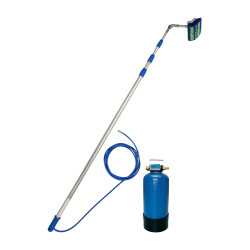
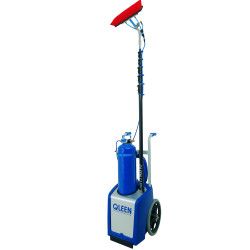
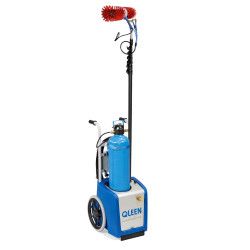
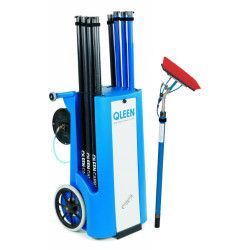
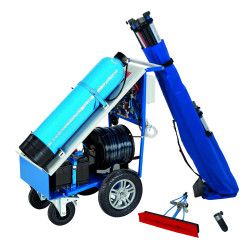
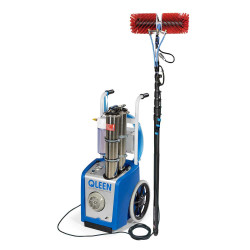
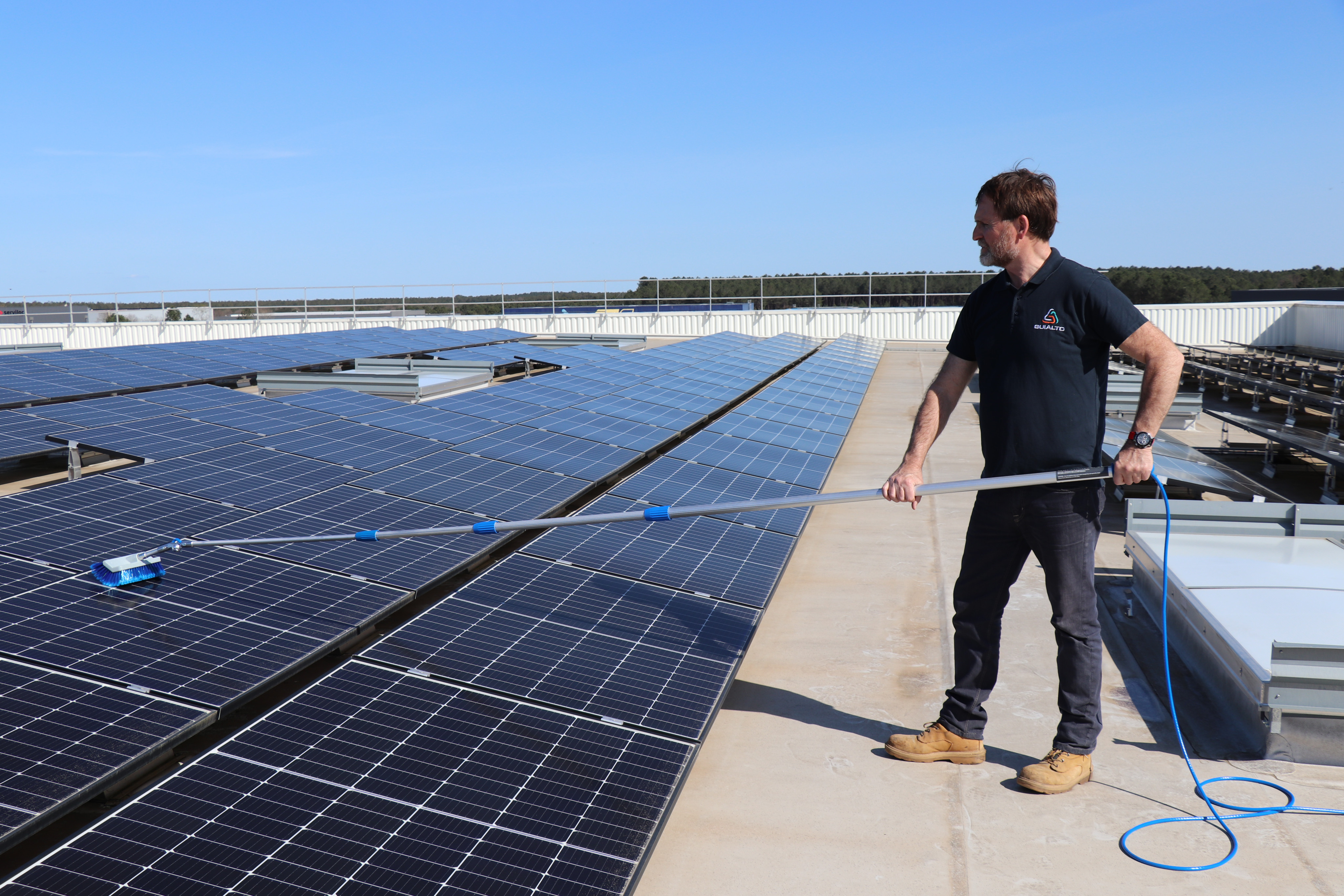
• Telescopic cleaning poles, connected to a water supply and equipped with a rotating brush.
• Cleaning robots,
• Specialized drones.
Lifts can also be used. Finally, for small surfaces, it is also possible to use a sponge, a soft cloth, and a garden hose.
Focus on pure water, or deionized water
For an optimal, streak-free result, choose pure water cleaning! This innovative process is based on the use of demineralized water filtered of impurities, making it free from both chemicals and particles. Its composition therefore reduces the formation of lime deposits. Lime creates a white film that reflects sunlight. Combined with a quality brush, pure water provides impeccable results (widely used for cleaning glass surfaces) and helps maintain the efficiency of your electricity production.
Focus on the Vario rotating brush
Designed by Qleen, a specialist in cleaning equipment manufacturing, this tool—highly efficient, easy to use, and extremely durable—can clean up to 250 m² per hour. Thanks to its different formats, this brush easily adapts to any installation.
The big day
Is today the day your solar panels get a makeover? Excellent news for your performance! However, don’t rush: a few steps must still be followed to ensure cleaning is carried out under the best conditions.
Step 1: Electrical safety
Before starting to clean your solar panels, it is essential to cut the power supply. The circuit breaker of the photovoltaic panels, the inverter, and the DC isolator must all be set to “off.” Then, to eliminate any risk of electric shock, it is necessary to check the absence of voltage.
Step 2: Fall prevention when working at height
While photovoltaic panels can sometimes be installed on the ground, they are most often located at height, on roofs that can be very tall. Climbing onto them to clean the panels therefore involves a significant risk of falling. Once again, all precautions must be taken to manage this hazard. First, you must be trained in this practice and have the appropriate safety equipment. Then, ensure that the equipment is properly installed and that weather conditions are suitable. Some cleaning solutions, such as telescopic poles, allow the user to remain safely on the ground throughout the process.
Step 3: Adjusting the water temperature
This step may seem trivial, but it is not. It is very important to use lukewarm water. If the water is too cold or too hot, the temperature difference between the water and the solar panels could damage them. In general, using an outdoor water source ensures that the water is at the same temperature as objects outside the building.
Step 4: Avoid walking on solar panels
Even though your solar panels are solid and designed to withstand the elements, applying weight to them can cause particularly harmful microcracks.
Need more advice on organizing the cleaning of your solar panels? Our team will be happy to answer your questions and guide you toward the services and equipment best suited to your needs.
-
 Standards and regulations governing the cleaning of solar panels
With the growth in renewable energy installations, cleaning solar panels is essential to ensure their performance and...Read more
Standards and regulations governing the cleaning of solar panels
With the growth in renewable energy installations, cleaning solar panels is essential to ensure their performance and...Read more -
 Why choose pure water cleaning?
Cleaning with Pure Water is an innovative, ecological and economical method that optimises the efficiency of solar...Read more
Why choose pure water cleaning?
Cleaning with Pure Water is an innovative, ecological and economical method that optimises the efficiency of solar...Read more -
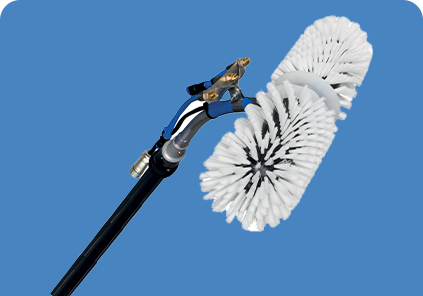 Robot vs rotating brush, which is the best solution for cleaning solar panels?
To maintain optimum energy yield from a solar panel, it needs to be cleaned regularly. This maintenance removes the...Read more
Robot vs rotating brush, which is the best solution for cleaning solar panels?
To maintain optimum energy yield from a solar panel, it needs to be cleaned regularly. This maintenance removes the...Read more -
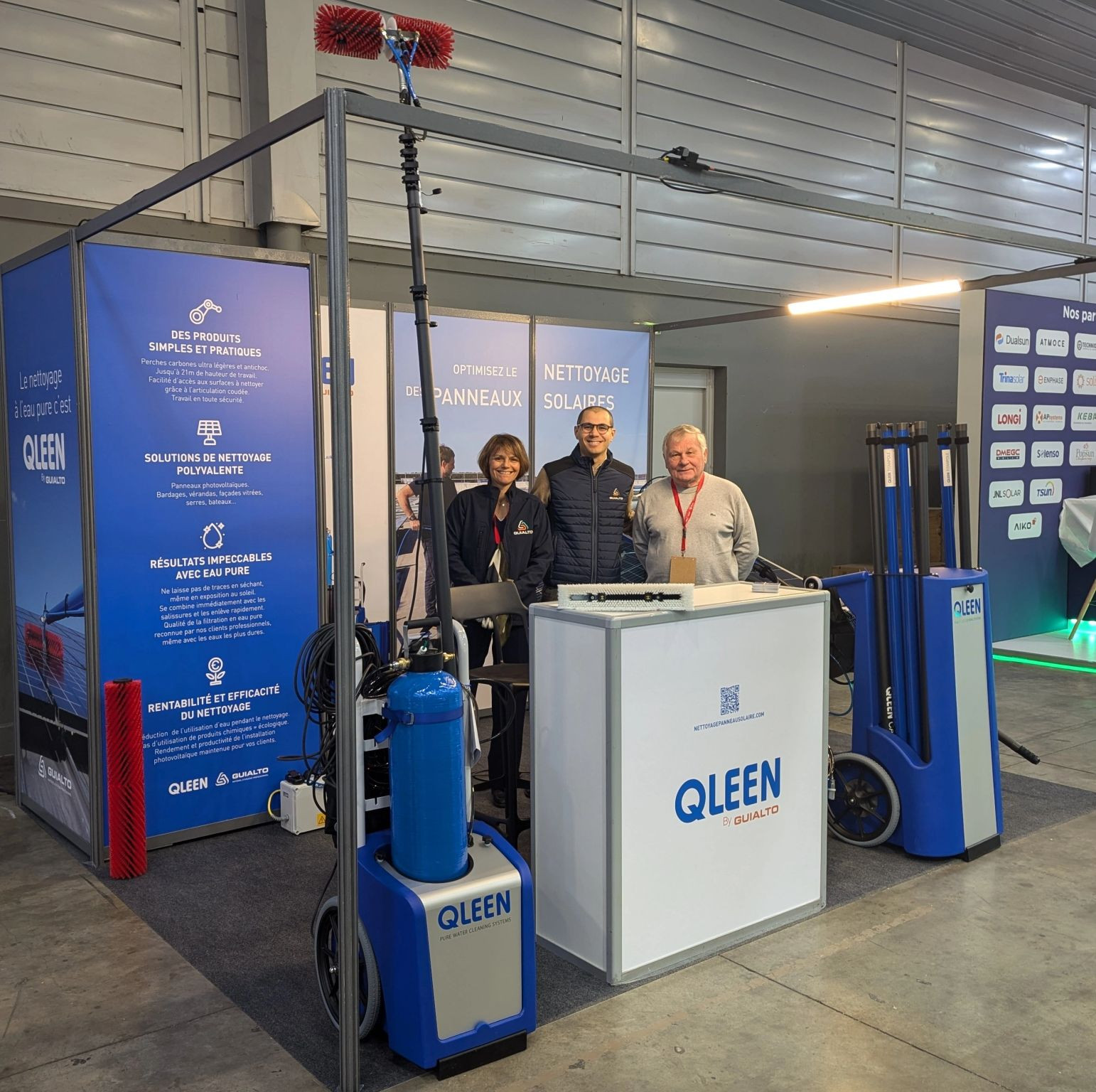 Qleen at Energaia
Many companies specialising in the cleaning and maintenance of solar panels have discovered Qleen equipment. Robust,...Read more
Qleen at Energaia
Many companies specialising in the cleaning and maintenance of solar panels have discovered Qleen equipment. Robust,...Read more -
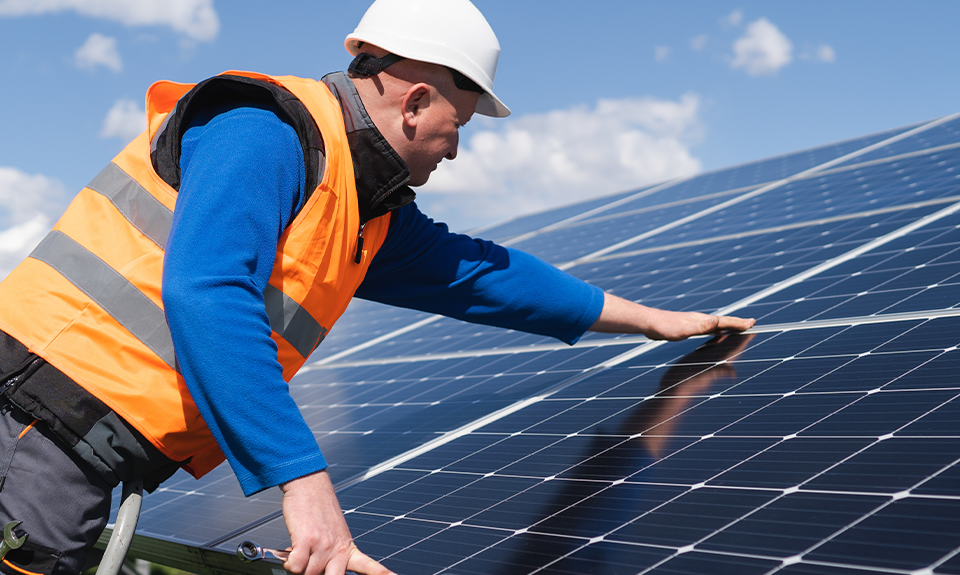 Optimise your solar panel cleaning service: choose the right equipment for your needs
Cleaning solar panels is essential to guaranteeing their efficiency and maximising their energy output. Over time,...Read more
Optimise your solar panel cleaning service: choose the right equipment for your needs
Cleaning solar panels is essential to guaranteeing their efficiency and maximising their energy output. Over time,...Read more