
 Français
 English
 Italiano


Solar panel cleaning: what does it really cost in 2026?
Most solar panel owners know it: a dirty panel produces less energy. But when it comes to putting a figure on cleaning, the prices you find online can vary tenfold — anywhere between €1 and €15 per square metre depending on the source. That range is meaningless unless you understand what drives it. Here's a breakdown, with concrete figures and the questions owners ask most often.
What really makes cleaning prices vary
Before quoting price ranges, it's worth understanding why two similarly sized installations can attract very different rates. Four factors genuinely matter.
The first is roof accessibility. It's often the most significant. A flat, easily accessible roof will cost two to three times less to clean than a steeply pitched one requiring a harness or platform lift. Some contractors apply a surcharge of 30% to 50% as soon as the configuration is complex — turning a €200 quote into a €300 invoice.
The second factor is the degree of soiling. Panels that haven't been cleaned for three years, covered in lichen or encrusted bird droppings, require a very different approach from a standard annual service. For a first clean after a long period of neglect, expect to budget 20% to 40% more than for a routine visit.
Next comes installation size. The larger the surface area, the lower the per-square-metre rate — economies of scale work strongly in favour of larger jobs. A contractor charging €10/m² for a small residential installation will often offer €4 to €5/m² for a site covering several hundred square metres.
Finally, location affects labour costs. Areas with a high density of specialist companies tend to be more competitive than less well-served regions.
Market rates in 2026, by installation size
For a standard residential installation (3 to 6 kWp, or 20 to 40 m²), expect to pay between €150 and €400 for a visit under normal access conditions — roughly €5 to €10/m². Difficult configurations push the bill to between €200 and €600.
For professional-scale installations, per-square-metre rates fall with volume:
- Between 30 and 50 kWp: €5 to €7/m², or €1,200 to €2,000 for a full clean
- Between 50 and 100 kWp: €4 to €6/m², averaging €1,800 to €2,400
- Over 100 kWp: €3 to €5/m² — large arrays benefit from the best rates
Some contractors charge per panel rather than per square metre, typically between €5 and €15 per unit. This approach can be more cost-effective for smaller installations with large-format panels.
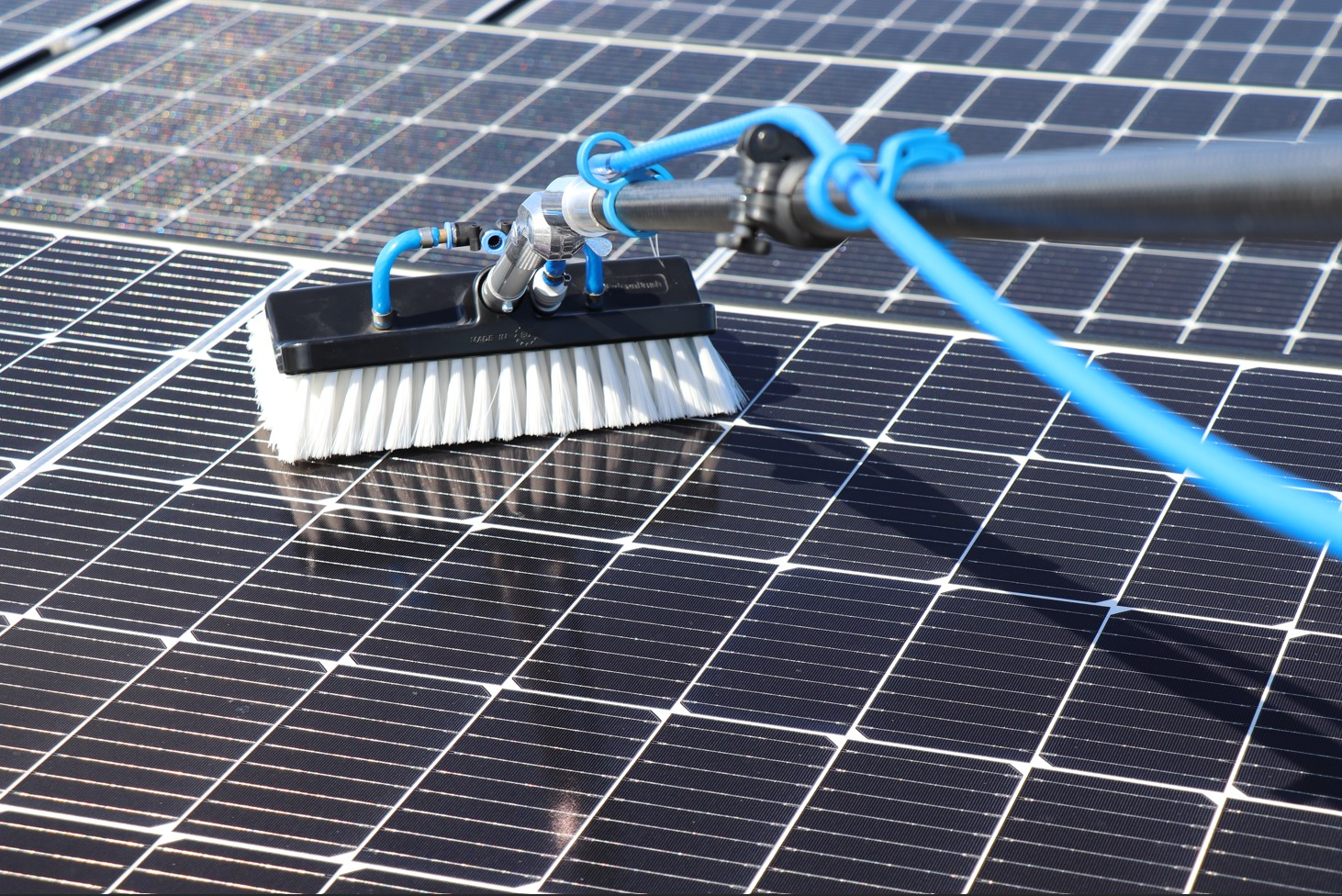
Note: these rates cover cleaning of the panels' glazed surface. Specific treatment of encrusted lichen or moss, where needed, is usually charged separately. For pure water cleaning — the professional method that leaves no streaks or limescale deposits — expect a slight premium of 10% to 20% over a standard clean, reflecting the quality of the long-term result.
Is solar panel maintenance actually required?
On the question of legal obligation, the answer is nuanced. There is no legislation in France — or across most of Europe — imposing a specific cleaning frequency for private photovoltaic installations. That said, almost all manufacturer warranties recommend regular maintenance, and some contracts include exclusions in cases of clear neglect.
The economic argument is often more compelling than any regulatory one. On a 6 kWp installation producing 6,500 kWh per year, a 10% drop in output due to soiling represents around €130 in lost production annually (at €0.20/kWh). The cost of an annual service is therefore often lower than the energy losses it prevents.
Professional service or own equipment: what's the real maintenance cost?
This question comes up often, and the answer depends mainly on how frequently you'll be cleaning — not on the initial outlay.
For a homeowner cleaning once a year: hiring a professional is usually the simpler option, particularly for elevated installations. Annual costs stay manageable, and equipment investment takes several years to pay back.
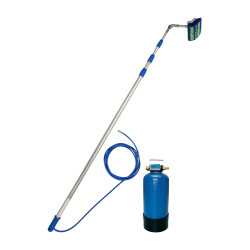
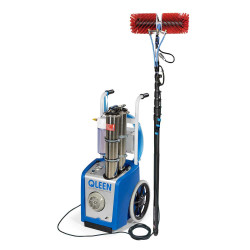
For someone who wants to clean twice a year, or who prefers to handle maintenance themselves, a kit with a telescopic pole and brush pays for itself within two or three seasons. The QLEEN Essential Kit is designed for this profile: straightforward to use from the ground, no ladder required, for residential installations up to 50 m².
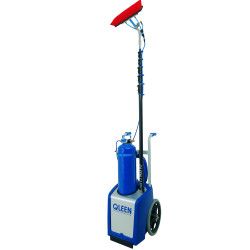
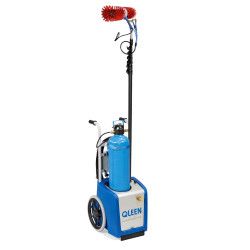
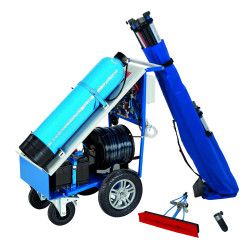
For an installer or maintenance company working across multiple sites, the calculation shifts entirely. A pure water machine with rotary brush — such as the PURASTART range — cleans 250 m² per hour with a guaranteed streak-free result. The equipment pays for itself within a few months of use, and each visit becomes a value-added service rather than an outsourced task. For professional photovoltaic cleaning businesses, this is often the key factor in service profitability.
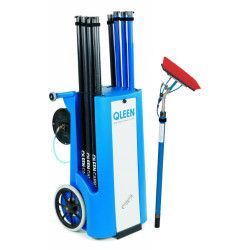
For operators of large ground-mounted arrays, the situation is different again. The Q-SUN robot is built for large flat panel surfaces: it combines a rotary brush and pure water system, delivering high cleaning speeds on level configurations. It makes sense when the surface to be maintained regularly exceeds 500 m² and labour costs represent a significant recurring expense. For large installations with height constraints, the DISY and PROFI solutions can reach up to 21 m using carbon and titanium poles.
If you're unsure which solution best suits your situation, our team can help you assess your needs — surface area, planned frequency of use, type of installation. Contact us for personalised advice.
-
 Standards and regulations governing the cleaning of solar panels
With the growth in renewable energy installations, cleaning solar panels is essential to ensure their performance and...Read more
Standards and regulations governing the cleaning of solar panels
With the growth in renewable energy installations, cleaning solar panels is essential to ensure their performance and...Read more -
 Why choose pure water cleaning?
Cleaning with Pure Water is an innovative, ecological and economical method that optimises the efficiency of solar...Read more
Why choose pure water cleaning?
Cleaning with Pure Water is an innovative, ecological and economical method that optimises the efficiency of solar...Read more -
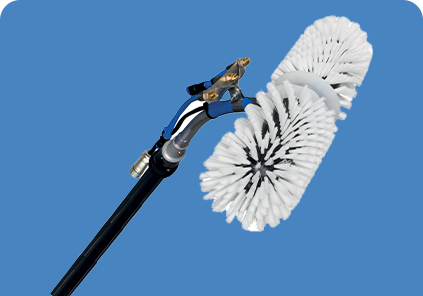 Robot vs rotating brush, which is the best solution for cleaning solar panels?
To maintain optimum energy yield from a solar panel, it needs to be cleaned regularly. This maintenance removes the...Read more
Robot vs rotating brush, which is the best solution for cleaning solar panels?
To maintain optimum energy yield from a solar panel, it needs to be cleaned regularly. This maintenance removes the...Read more -
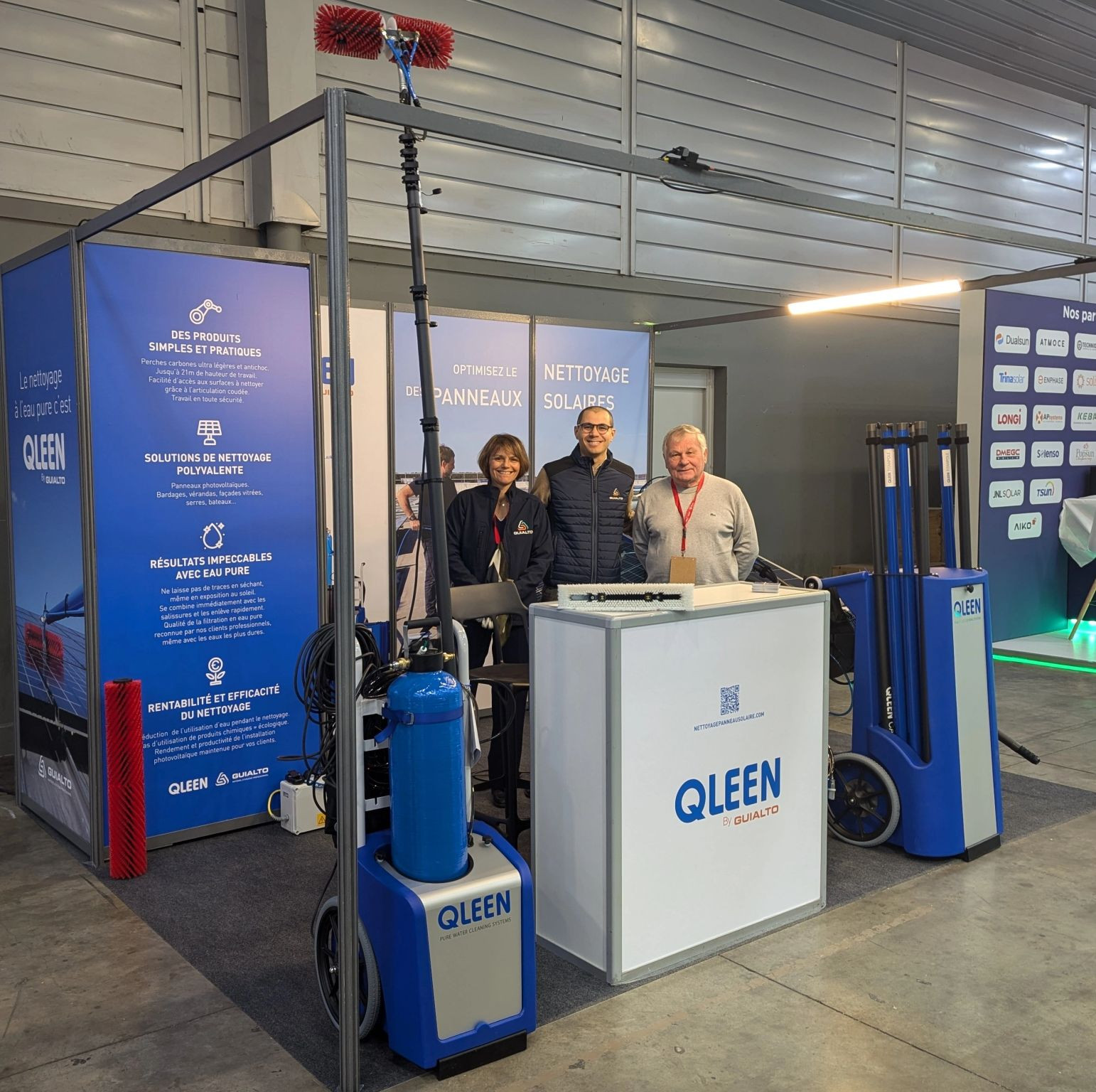 Qleen at Energaia
Many companies specialising in the cleaning and maintenance of solar panels have discovered Qleen equipment. Robust,...Read more
Qleen at Energaia
Many companies specialising in the cleaning and maintenance of solar panels have discovered Qleen equipment. Robust,...Read more -
 Optimise your solar panel cleaning service: choose the right equipment for your needs
Cleaning solar panels is essential to guaranteeing their efficiency and maximising their energy output. Over time,...Read more
Optimise your solar panel cleaning service: choose the right equipment for your needs
Cleaning solar panels is essential to guaranteeing their efficiency and maximising their energy output. Over time,...Read more